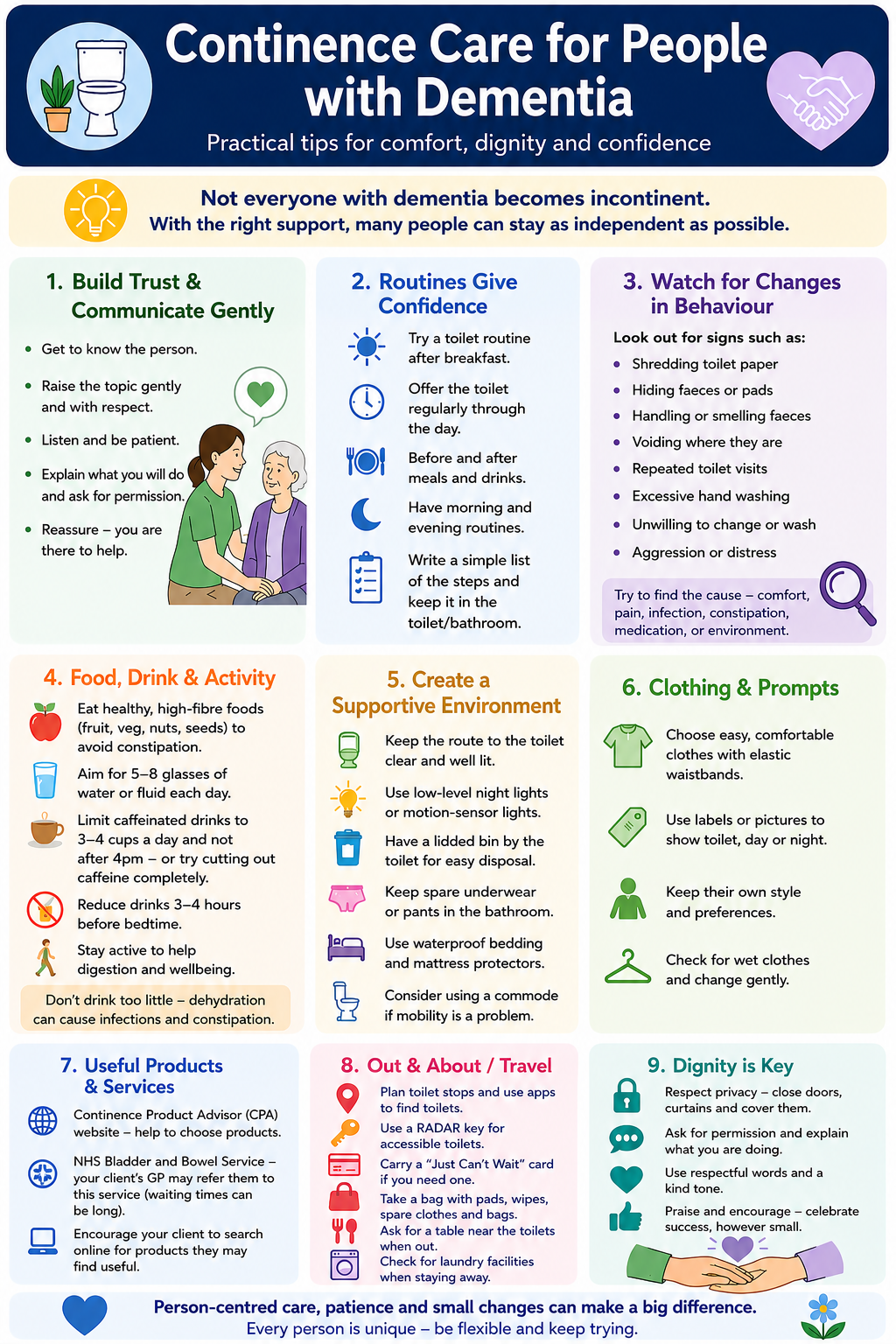
About this guide
This guide may help you manage continence when caring for people living with dementia. Experienced homecare workers have been involved throughout its development and advised on the contents so that it is relevant to the needs and challenges you face in your role. All quotations are from homecare workers and include their experience of caring for and advice on how to support people with their continence. Having conversations on incontinence can be difficult and we hope this guide will help.

“This guide provides benefit and value to me – it’s a great resource!”
“This information gives me an extra level of assurance and certainty in my work. If I don’t know, there is clear, unbiased advice I can go to, to get extra support”.
How to use this guide
You can use this guide:
- To help start a conversation with a client on how they are managing their continence
- To plan care together
- As a go-to resource for you and your clients when you need it.
Choose the sections from the menu that are useful for you. Each section has key points (for when you’re in a hurry) and additional detailed information (for when you have more time). The guide is full of practical information and there are boxed practical tips highlighted to help you pick out ideas quickly. There are also links to take you to other sections of the website that may be helpful.
Speak to your supervisor or manager if you are unsure about anything and always follow the protocols of your employing organisation.

“I feel confident that, by following this guide, it will enable me to manage a client with dignity, confidence and in a careful manner”.
Choice of language
Getting words right is important for continence care, to encourage conversations on a difficult subject. As a homecare worker you will be aware that your clients may use informal terms, such as ‘pee’ for urine and ‘poo’ for faeces. It’s important to use the words that work best with each of your clients. By listening out for their choice of words you can use the same terms when speaking to them.
Incontinence refers to the involuntary voiding of urine and faeces. We have used the terms ‘accident’ and ‘leakage’ in this guide, when referring to incontinent episodes and their management.
People who have dementia and are not native English speakers may revert to talking in their native language, especially as their condition progresses. In this case, you may find it helpful to use Google Translate to find words your client might use for going to the toilet.
We’ve listed some of the common words and terms used for passing urine (or urinating) and faeces (or defaecating) below.
| Urine | |
|---|---|
| Answer the call of nature | Point Percy at the porcelain |
| Cock my leg | Relieve oneself |
| Empty one’s bladder | Shake hands with an old friend |
| Go for a wee | Spend a penny |
| Go to / use the bathroom | Splash one’s boots |
| Go to / use the loo | Take a leak |
| Have a slash | Take a piss |
| Have a whiz | Take care of business |
| Jimmy Riddle | Tinkle |
| Make water | Urinate |
| Micturate | Use the little boy’s room |
| Need to go | Wanting to go |
| Number one | Wee |
| Pass water | Wee-wee |
| Piddle | Widdle |
| Faeces | |
|---|---|
| Answer the call of nature | Have a shit |
| Bowel Movement | Move or open the bowels |
| Code brown | Need to go |
| Crap | Number two |
| Defecate | Other side of the job |
| Do a whoopsie | Pass a motion |
| Do the business | Pass stool |
| Drop a bomb | Pinch a loaf |
| Drop a log | Poop |
| Empty the bowels | Relieve oneself |
| Evacuate | Shit |
| Excrete | Stool |
| Faeces | Touching cloth |
| Go for a dump | Void one’s bowels |
| Have a BM | Want to / need to go |