
12. How can I assist my client to socialise?
Key points

Maintaining social connections
People with dementia who have incontinence problems may worry about being incontinent when they go out. This can make them feel anxious and afraid to leave the house. Over time, they may stay home more and become socially isolated. Social isolation can lead to feeling lonely, sad, anxious or unsettled. It can also make memory decline, sleep problems and difficulty with self-care worse. Staying socially active is good for both mental and physical health, and should be encouraged.
If your client starts to find walking hard or tiring, you could suggest they use a wheelchair for outings. This might help them access a toilet more quickly if needed, and encourage them that they can still go out and about. Talk with them about their worries and help them manage the things they can control. Their concerns may be different depending on whether they are with family or friends, or visiting unfamiliar places. By understanding these concerns you can help them plan and prepare for social activities and feel less worried.
Encourage your client to invite their friends and neighbours round for a cup of tea or coffee. This will help them stay socially active and will be especially important if or when they find it more difficult to go out. You can help them by ensuring they go to the toilet in good time before their visitors arrive and putting discreet protection on their chair. If there is an incontinence aid in the room, such as a commode, this can be covered by a throw.

“Socialising should be enjoyable without it being a really stressful event”.
Managing anxiety and overcoming fears
Encourage your clients to create routines that reduce uncertainty, such as:
- Planning and preparing for a social outing or receiving visitors.
- Allowing extra time to get ready and travel.
- Using the toilet just before leaving the house/receiving their guests.
Try to understand what is making your client anxious and help them manage it. When they feel more in control, they may be more willing to go out or invite their friends home, and better able to cope with anything unexpected.
“It’s about managing the anxiety, but it’s actually about discovering what the anxiety is in the first place”.
Preparing and planning for outings
Visiting an unfamiliar place can be more stressful than seeing friends or family. Good preparation can help reduce anxiety. Support your clients to plan ahead and take anything they may need. Tasks such as going to the toilet may take longer, so encourage them to allow extra time.
- Knowing where public or accessible toilets are can ease worries.
- Encourage clients to use a toilet-map App on their phone to find nearby public toilets in the UK (and abroad, if travelling).
- If eating out, suggest they ask for a table near the toilets and check where the toilets are when they arrive.
- A RADAR key can open over 10,000 accessible toilets across the UK. These can be obtained from Amazon, some charities, and most local authorities at low cost or for free. The Great British Public Toilet Map online shows where these toilets are located. Encourage clients to check this before going out.
- A “Just can’t wait” card, available from Bladder & Bowel UK, can give access to toilets not usually available to the public.
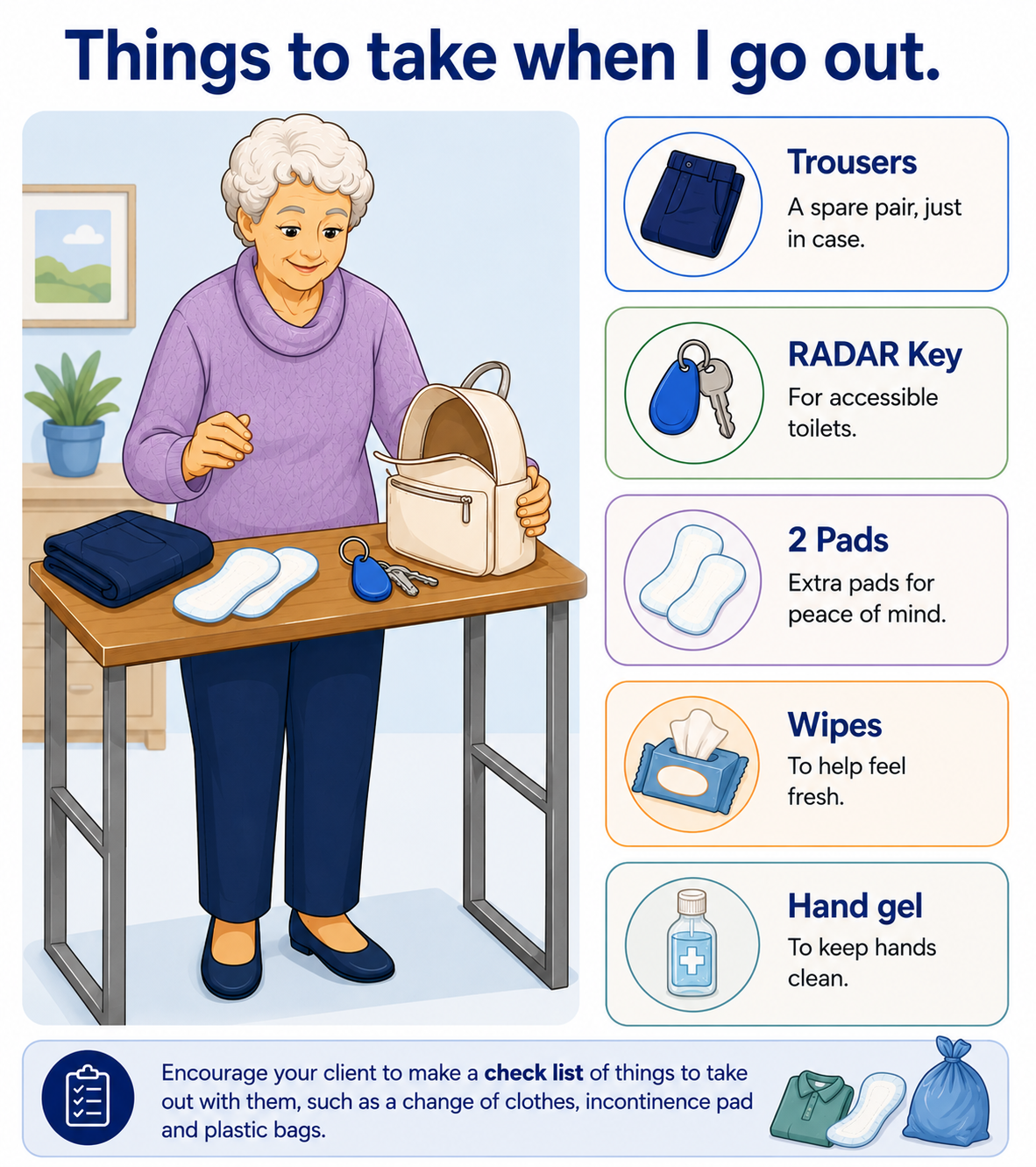
- Suggest they take spare clothes and any incontinence products they use. A small towel and some tissues or wipes may also be helpful. Suggest they take a plastic bag to put any wet clothes in and another bag to dispose of a wet or soiled pad.
- If travelling by car, suggest they protect their car seat (see Section 11) if worried.
It is useful to have a bag packed with a complete set of spare clothes, spare incontinence pads, cleaning wipes and plastic bags, that goes everywhere with the client when they go out, kept for use in an emergency. You might suggest to your client that they write a checklist of things to take with them in case they need to manage an incontinent accident.
“Spare clothes in the backpack – that’s really important. But there is always going to be a time when you’re not going to have enough spare clothes or enough spare pads, because it’s just one thing after another and it’s about being prepared for that as well. So, it could be that if you’re taking the car, having a grab bag in the car additional to the grab bag that you take out on a day-to-day basis”.
Practical Tips
- Discuss any concerns your client might have about going out so that you can help them manage and overcome them.
- A personalised checklist of what to take with them can help them prepare and pack supplies for an emergency.
- A RADAR key gives access to accessible toilets around the UK.
- Taking incontinence products that protect bedding can help manage anxiety about have accidents at night when on holiday.
Telling someone with dementia the night before an outing can make it hard for them to sleep. They might wake up very early, or start washing and getting dressed in the middle of the night. It can be better for some people to tell them on the day of their activity.
“In some instances it’s best to tell them no more than an hour beforehand, because that can cause anxiety. Let’s say you’re going out this morning. You tell them in the morning because if you tell them at night, they won’t sleep ”.
Staying away from home
When your client is planning a holiday or short break away, you can help them to prepare by encouraging them to:
- Pack additional incontinence products to protect bedding.
- Pack extra clothes, including nightwear, in case accidents happen.
- Take a supply of bin bags to discard soiled clothing, pads and bed protection products. ‘Double bagging’ -that is, putting the bag of soiled products inside a second bag - will help contain smell and avoid leakage from soiled items.
Although taking extra supplies on holiday may seem to be a bit inconvenient and bulky, being prepared for accidents will help reduce potential anxiety of this happening and reassure your client that they can still travel and enjoy their trip.