1. What is Dementia?

Key points


lightbulb

Dementia: an overview

Dementia refers to a range of conditions that damage parts of the brain, affecting behaviour and memory. It usually gets worse over time. Changes can be gradual and take place over several years. Or people can decline quickly over a few months, with sudden changes to behaviour and mental ability. Caring needs for a person with dementia have to be led by the changes you see in your client.

Many people don’t like to talk about dementia or ask for help. Your client and/or their family may refer to memory issues or forgetfulness, rather than dementia, so it’s helpful to listen out for their choice of language and reflect it back. The World Health Organisation has reported very low rates of dementia diagnosis worldwide and some cultures don’t have a word for dementia, which can lead to myths and misunderstanding. It is important to raise awareness about the disease and how it might affect the person.

Myths and reality

Myth Reality
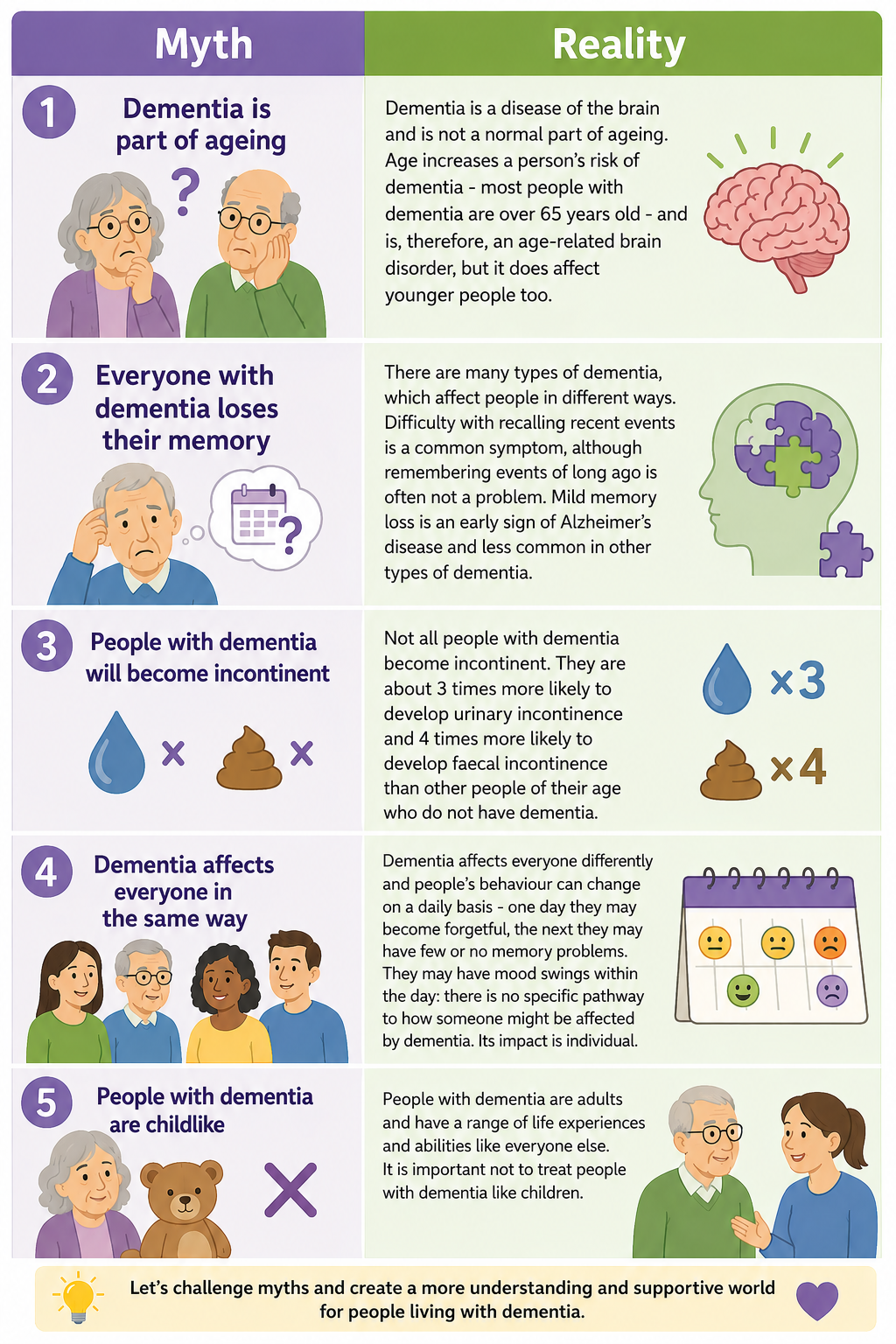
Dementia is part of ageing Dementia is a disease of the brain and is not a normal part of ageing. Age increases a person’s risk of dementia - most people with dementia are over 65 years old – and is, therefore, an age-related brain disorder, but it does affect younger people too.
Everyone with dementia loses their memory There are many types of dementia, which affect people in different ways. Difficulty with recalling recent events is a common symptom, although remembering events of long ago is often not a problem. Mild memory loss is an early sign of Alzheimer’s disease and less common in other types of dementia.
People with dementia will become incontinent Not all people with dementia become incontinent. They are about 3 times more likely to develop urinary incontinence and 4 times more likely to develop faecal incontinence than other people of their age who do not have dementia.
Dementia affects everyone in the same way Dementia affects everyone differently and people’s behaviour can change on a daily basis – one day they may become forgetful, the next they may have few or no memory problems. They may have mood swings within the day: there is no specific pathway to how someone might be affected by dementia. Its impact is individual.
People with dementia are childlike People with dementia are adults and have a range of life experiences and abilities like everyone else. It is important not to treat people with dementia like children.

Common dementias and their main differences

There is a lot of overlap between the symptoms and impact of the various types of dementia, particularly as the disease progresses. The symptoms and effects below are some examples of common things you may observe, and are not limited to the dementia type they are listed under.

We don’t know exactly how different types of dementia affect a person’s ability to remain continent.

Dementia type Characteristics Symptoms Effect
Alzheimer’s disease Abnormal structures called tangles and plaques build up in the brain
  • Memory loss
  • Forgetfulness and confusion regarding familiar things
  • Becoming withdrawn or having mood swings
  • Difficulty with recall of events and learning new information
  • Getting lost in familiar places
  • Problems with language
  • Getting muddled
Vascular dementia Problems with blood supply to the brain. May follow a stroke or a series of mini-strokes – also called TIAs (transient ischaemic attacks)
  • Difficulty planning, thinking quickly or concentrating
  • Becoming withdrawn
  • Memory loss
  • Increasing communication difficulty
  • May become depressed or anxious
  • May become confused for short periods
  • Unsteady walking
  • Reduced ability to self-care
Lewy body dementia

(Parkinson’s dementia is very similar)
Small clumps of protein (called Lewy bodies) form inside nerve cells in the brain, affecting how the brain works
  • Difficulty with staying alert, planning ahead, reasoning and solving problems
  • Disturbed sleep patterns
  • Symptoms typically vary a lot from day to day
  • May find it hard to judge distances
  • Difficulty seeing objects in 3-D
  • May have visual hallucinations
  • May develop problems balancing, slow and rigid movements or trembling of limbs
Frontotemporal dementia Develops usually in people in their 40s – 60s, due to damage in the frontal and temporal lobes of the brain
  • Behavioural and personality changes
  • May have problems with speech and understanding
  • Loss of ability to demonstrate basic emotions
  • May become withdrawn or uncaring towards others
  • May behave inappropriately in social situations
  • May become impulsive
  • Lose ability to speak, or getting words out
  • Do not understand the meaning of words
Mixed dementia More than one type of dementia is present; this is usually a combination of Alzheimer’s and vascular dementia, or Alzheimer’s and Lewy body dementia Symptoms and their effects from both types of dementia are likely to be present.