
7. How can I help my client choose continence products?
Key points

Using products
Incontinence products can give people confidence to keep going out and seeing others, even if they are worried about having an incontinent episode. Most people with dementia who need products use absorbent pads or pants, but there are other products such as urinary sheaths that might be suitable for some people. Many people benefit from using more than one type of product (for example one type at night and another during the day). It's important to use products correctly or they won’t work as well as they should. Guidance is provided on the product packaging. Explain to your client that they should wear/use only one pad at a time: two pads do NOT provide double protection. The Continence Product Advisor website has more information.
Taking a couple of samples on a home visit can make it easier to start the conversation with your client. If you notice signs of incontinence you can refer them to the local NHS Bladder and Bowel Service. They can give advice on managing incontinence, the different types of products available and the products they can supply through the NHS. In some areas, getting an appointment can take a long time - sometimes 6 to 12 months. It’s best to contact the service as soon as you notice any incontinence issues.

“Incontinence (can creep) up on you. So, the clients may have been using something, so you can say: ‘Oh, what have you used before? Were you happy with it? What do you think would be better? And you can produce … my inco kit is literally one pair of pants, one liner, that’s all I’ve got, but it aids the discussion. So, I put: ‘Right, what do you think of these?’ So, it starts the discussion off. Just show people: ‘Right, this, this and this is available. I notice you’ve been using this, how happy are you with it’? They’ve probably used something in the past so they’ve got some sort of idea what they like”.
Choosing products
- Some incontinence products are available on the NHS. If the client is going to be regularly using products, they should be referred to the local Bladder and Bowel Service for assessment.
- There is more choice if people buy their own: pads and pull-ups are easily available in supermarkets, pharmacies and online.
- A local mobility aids shop may stock other incontinence products such as urinal bottles.
- Some companies offer free samples of pads through their websites. This can help you and your client decide what works best, without cost.
- If the person has very light leakage, washable incontinence pants might be better than disposable pads.
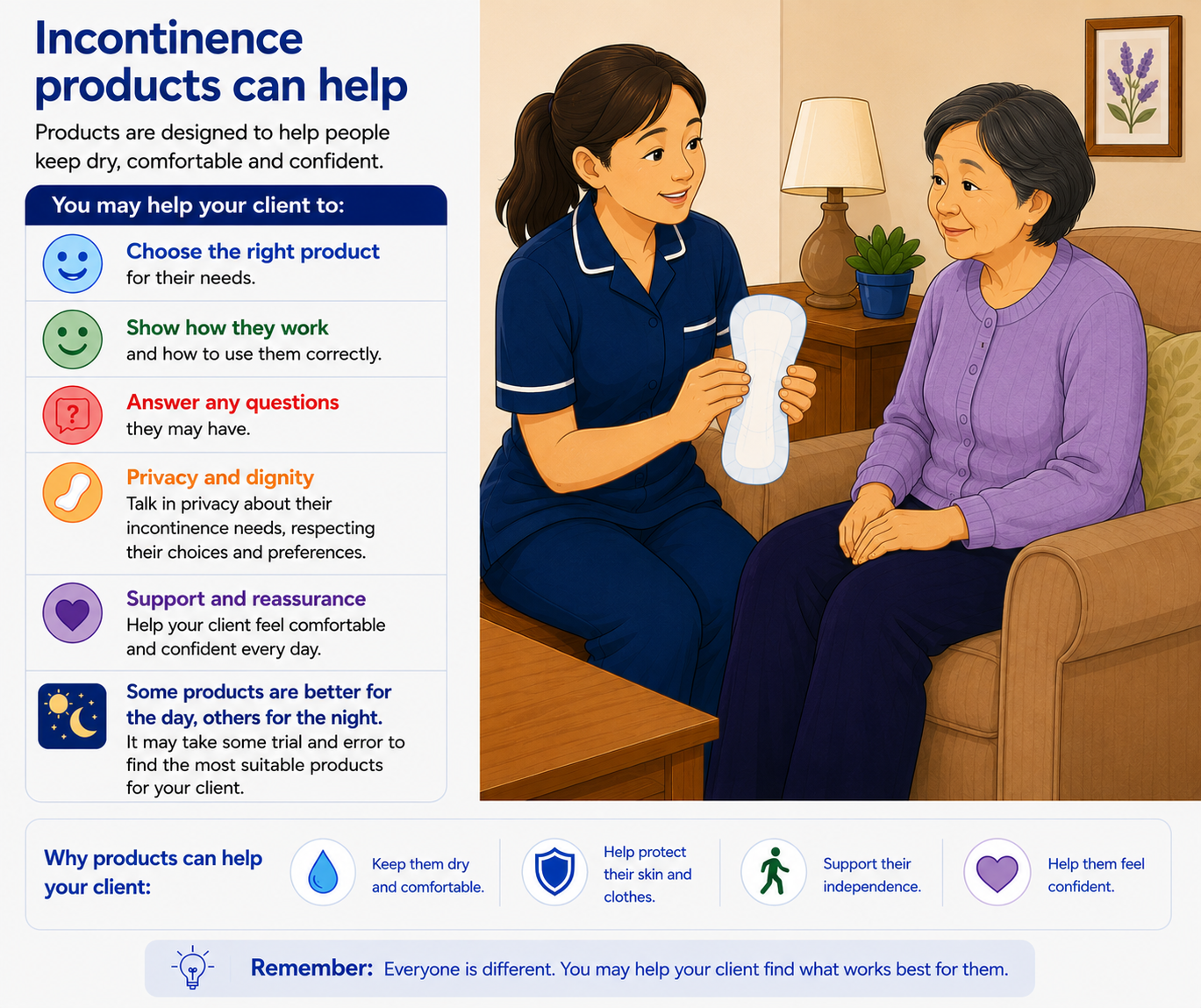
Samples can help you start a conversation with your client:
“ ‘Right, they’ve sent this free for you. Would you like a try?’ If they say no, then they haven’t spent any money. But more often than not they say: ‘Ooh yes, I’ll try it and see what it’s like’, and then that opens the subject again for you. Basically, they’ll order some more then”.
Different products for different needs
- Some products are better for the day, others for the night.
- A client may be incontinent only at night. Options include:
- Incontinence pads or pants.
- Urinary sheath (often called a Conveen) for men (see section 10).
- Waterproof mattress and duvet protectors (see section 11).
- Having a commode or urinal bottle nearby (bedroom or living area) can make things easier for people with mobility problems.
If a client doesn’t want to have a commode or bottle visible, find ways of disguising them. For example, putting the bottle in a bag and putting a blanket/throw over a commode.
“It may be that to somebody who’s having those mobility issues and that urgency to go, it may be that the gentleman says: ‘Well, this is really helpful’. And the wife says: ‘I don’t like that (urinal) being on the living room table’. And it’s about adapting that so it’s going to work. It could be: ‘Alright, have a little box next to the chair, so that it is just reachable’ ”.
You may need to test different products to find the best one. Incontinence pants can vary in fit, comfort and price. Some types are washable. Things to think about are:
- Does the person leak pee and poo, or just pee?
- Does the continence product contain leakage?
- Is it discreet (other people don’t know it is being used)?
- Does it contain the odour?
- Does it stay in place?
- Is it comfortable?
- Does it keep the skin dry?
- How often will it be changed? If the product can be changed frequently, the client might prefer a smaller pad.
“I know people that have gone: ‘Actually, this pad’s better for me’, and it’s just, it’s experimenting to work out what’s most comfortable, what works best”.
Disposing of products
Some people may not know where to put used incontinence pads or pants. You might give suggestions to your client, such as:
- Keeping a lined bin with a lid in the toilet or bathroom.
- Having a written reminder, if needed, to use the bin.
- Using nappy sacks to dispose of individual pads or pants.
- Keeping a stock of bags in the bathroom/toilet.
“I had a client last year who had dementia, would take their pad off and would just leave them in the downstairs toilet and there would be quite a collection, or they would go and hide them because they were embarrassed”.
Incontinence pads are usually disposed of in general household waste. Some local authorities may provide an extra household refuse bin if requested. It is worth checking with your client’s local authority whether they require an alternative disposal method for incontinence products (for example, using a clinical waste bin).
Practical Tips
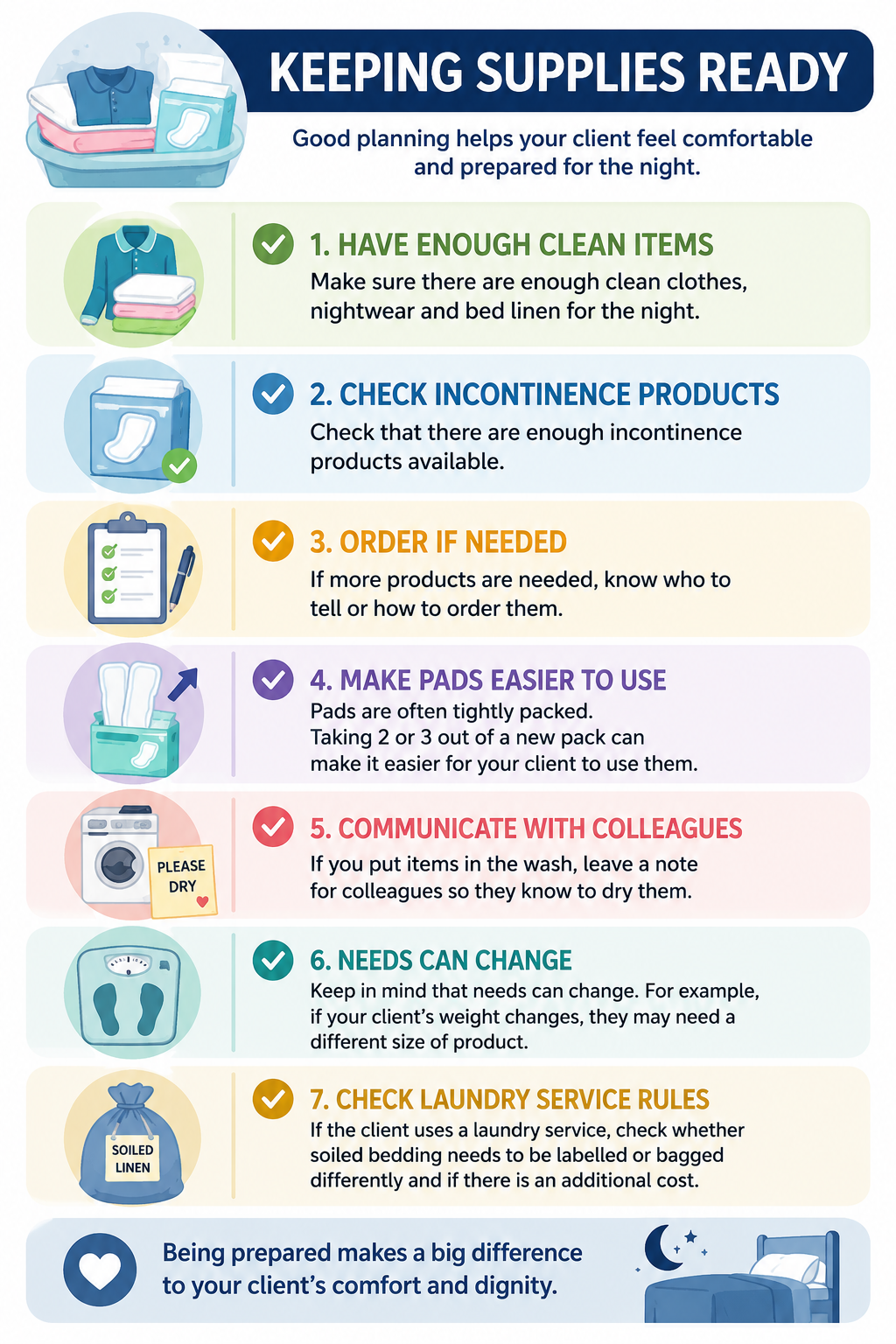
- Having a couple of samples (e.g. different types of pads) to show your clients can help a conversation about use of products.
- It may take a while for your client to find the right product(s).
- Your client might need different products for different times of day or activities (e.g. a different one for night-time).
- Keeping a lined and lidded bin in the bathroom/toilet is useful for easy disposal of used pads.
Product information
There are various incontinence products and equipment to choose from. The Continence Product Advisor website gives lots of useful information about what is available and what might be suitable for your clients.
More information on the DemCon website can be found in Section 4 for friends and family carers.
The AskSARA website is another useful site to help people find equipment and products that may be helpful, and how to get them.