
5. Managing at night
Key points
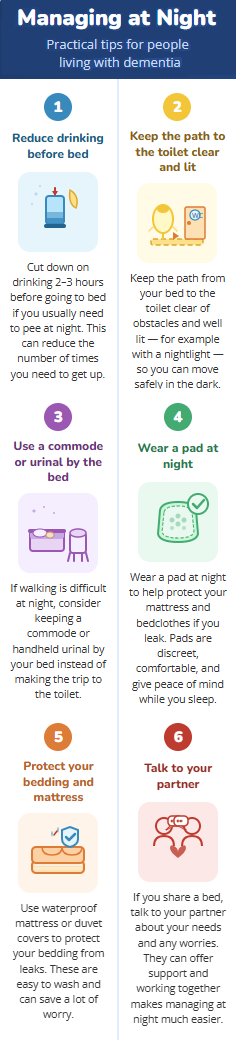
- Reduce fluid intake before bed.
- Have a night light to make it easy to find the toilet, or use a commode or handheld urinal.
- Use pads and protective covers for your bedding if needed.


“It's also about lowering the intake of fluid as the evening approaches as well. So, yes, drinking plenty, but by sort of 7.00pm or 8.00pm, slow it down so that you're actually not drinking as much before you go to bed”.
Olivia lives in S. E. England
Many people need to pee during the night. There are some things that you can do to make it easier to either get to the toilet or manage if you can’t get to the toilet.
If your toilet is far from your bedroom and you have problems with walking, think about putting a commode or having a urinal near your bed. This can help prevent being caught short if you can’t reach the toilet in time.
You might find it helpful to keep a low light (such as a wall plug nightlight) on at night to show the way to the toilet. Make sure the path from your bed to the toilet or commode is clear of hazards, such as pets, rugs and electric leads, to avoid tripping.
“We've got one (motion activated light) actually sort of on the way to the bathroom and then one in the bathroom so that you're not groping around in the dark. You can manage to use the loo and wash your hands”.
Caroline lives in S. W. England
If you have a partner with you at night they might notice that you are restless when you need to pee or poo. For some people it can be helpful to have someone there to remind them to use the toilet, but this can become stressful for the partner. Talk openly with your partner so you both know what to expect and can share worries.
Incontinence can change day to day, so managing it may take some trial and error. Wearing an incontinence product at night can help contain accidents in bed. It may also give peace of mind, especially if you sleep deeply.
“My wife keeps an eye on me. If I'm restless in bed, then she'll prompt me to say, ‘It looks like you need to go to the toilet’, and she wakes me up, because I get very drowsy as well and I can't wake up very quickly as well. So, she helps me at night as well that way”.
Syed lives in East Midlands
“I wear a pad and I've realised it's a bit, it's quite a bit damp, so obviously I have started to go while I've been asleep, but then I wake up and go to the toilet”.
Beth lives in S. E. England
Protecting your bedding
There are products to protect you, your bedding and your mattress. They can be disposable or washable. You can see examples on the Continence Product Advisor (CPA) website. Wearing incontinence protection at night, such as a pad, might help to contain leaks, protect your skin and help you feel more comfortable and less anxious.
Waterproof, wipe-clean duvet covers, pillows and mattress protectors are very useful if you have incontinence at night as they protect your bed and make cleaning up easier.
“I also had bed liners because the worst thing in the world is to be stuck in bed and then you’ve got your son or a friend stripping off and your mattress is wet or, you know, so you can get just little bed… under the bed cover. It’s like a bed thing, you know, you just lie in there”.
Lydia lives in N. W. England